Great news has broken that the Purple Herons at RSPB Dungeness have bred successfully.
On the RX Wildlife website, the RSPB have stated:
"The Purple Heron chicks were seen for the first time over the weekend. It is not possible to say how many are present but it appeared to be at least two individuals. We are expecting the oldest chicks to fledge shortly."
Birding in Surrey, Sussex and Kent

White-tailed Plover ... Wednesday 14th July 2010
Paul couldn't hold out any longer and he phoned me last night to arrange a trip to Dungeness today .. we had to add the White-tailed Plover/Lapwing to our life lists.
We set off at 5.15 a.m. and arrived at the Hanson-ARC Pit precisely one hour later. Two birders were already present at the viewing screen and kindly pointed out the plover, which was showing well but somewhat distantly.
To begin with, it was overcast but after 30 minutes or so, the skies cleared and viewing and digiscoping became a little more difficult.


WHITE-TAILED PLOVER (Paul)
(VIDEO) WHITE-TAILED PLOVER (Paul)

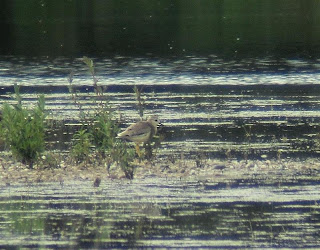
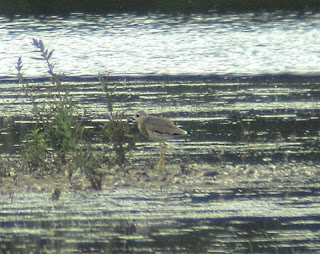
WHITE-TAILED PLOVER (Graham)
(DODGY VIDEO) WHITE-TAILED PLOVER (Graham)
One of the birders present pointed out a female Garganey not far from the plover and three Green Sandpipers were also nearby.
After having our fill of the plover, we headed for the 'Patch' for a seawatch. By now a decent onshore wind was blowing and we were expecting some decent birds to be on the move. On arrival, we met up with Steve Gale, who is staying at the Observatory this week.
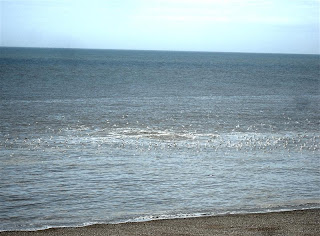
Gulls at the Patch
The Patch was covered in gulls, with a good number being Mediterranean Gulls (many of which were juveniles - 73 birds were reported as being present) and at least one Little Gull was present. Apart from a few distant Gannets, several Common Terns and three or so Sandwich Terns, nothing much else was noted.
We bid our farewells to Steve and headed on past the power station where we found three Wheatears. On our return walk, we located one female Black Redstart that conveniently perched on the roof of the concrete hide on the beach.

LITTLE GULL (Graham)

BLACK REDSTART (Graham)
Decision time -should we traipse around the trapping area or head for the RSPB reserve? We decided on the latter and, on our way, we spotted a Little Egret in flight at the Hanson-ARC Pit.
We saw at least two (maybe three) Hobbies at the reserve and three adult Mediterranean Gulls were roosting with other gulls not far from the car park. Three Marsh Harriers were quartering around the Dengemarsh/Hookers Pit area and several Cetti's Warblers were heard and one seen briefly but the reserve proved remarkably quiet, but it is July, so we couldn't expect it to be alive with birds yet.

MEDITERRANEAN GULL (Graham)
We spent some time at the viewing ramp and at the Dengemarsh Hide in the hope of seeing the Purple Herons, Bitterns or the Great White Egret that had been present yesterday, but we had no luck with any of them.
On leaving the reserve, we stopped by the entrance at Boulderwall Farm and saw seven Tree Sparrows, always a welcomed sight.
We ended our visit with a drive round to Dengemarsh Road where we joined several other birders waiting to see the Purple Herons, but they didn't show. As far as we could make out, they hadn't been seen today up to the time we left.
A few Yellow Wagtails were flying low across the field by the road.
Paul & Graham
We set off at 5.15 a.m. and arrived at the Hanson-ARC Pit precisely one hour later. Two birders were already present at the viewing screen and kindly pointed out the plover, which was showing well but somewhat distantly.
To begin with, it was overcast but after 30 minutes or so, the skies cleared and viewing and digiscoping became a little more difficult.


WHITE-TAILED PLOVER (Paul)
(VIDEO) WHITE-TAILED PLOVER (Paul)


WHITE-TAILED PLOVER (Graham)
(DODGY VIDEO) WHITE-TAILED PLOVER (Graham)
One of the birders present pointed out a female Garganey not far from the plover and three Green Sandpipers were also nearby.
After having our fill of the plover, we headed for the 'Patch' for a seawatch. By now a decent onshore wind was blowing and we were expecting some decent birds to be on the move. On arrival, we met up with Steve Gale, who is staying at the Observatory this week.

Gulls at the Patch
The Patch was covered in gulls, with a good number being Mediterranean Gulls (many of which were juveniles - 73 birds were reported as being present) and at least one Little Gull was present. Apart from a few distant Gannets, several Common Terns and three or so Sandwich Terns, nothing much else was noted.
We bid our farewells to Steve and headed on past the power station where we found three Wheatears. On our return walk, we located one female Black Redstart that conveniently perched on the roof of the concrete hide on the beach.

LITTLE GULL (Graham)

BLACK REDSTART (Graham)
Decision time -should we traipse around the trapping area or head for the RSPB reserve? We decided on the latter and, on our way, we spotted a Little Egret in flight at the Hanson-ARC Pit.
We saw at least two (maybe three) Hobbies at the reserve and three adult Mediterranean Gulls were roosting with other gulls not far from the car park. Three Marsh Harriers were quartering around the Dengemarsh/Hookers Pit area and several Cetti's Warblers were heard and one seen briefly but the reserve proved remarkably quiet, but it is July, so we couldn't expect it to be alive with birds yet.

MEDITERRANEAN GULL (Graham)
We spent some time at the viewing ramp and at the Dengemarsh Hide in the hope of seeing the Purple Herons, Bitterns or the Great White Egret that had been present yesterday, but we had no luck with any of them.
On leaving the reserve, we stopped by the entrance at Boulderwall Farm and saw seven Tree Sparrows, always a welcomed sight.
We ended our visit with a drive round to Dengemarsh Road where we joined several other birders waiting to see the Purple Herons, but they didn't show. As far as we could make out, they hadn't been seen today up to the time we left.
A few Yellow Wagtails were flying low across the field by the road.
Paul & Graham
Tern ID results:
There have been just four votes on the poll as to the identification of the tern in the previous post but I have also received five emails with opinions.
The results are:
Common Tern 3 votes
Arctic Tern 2 votes
Roseate Tern 4 votes
The emails have been widely differing in opinion and reasoning:
"Definitely Roseate, no other tern has a bill like that"
"..the long thin legs and black bill with red base make this a Roseate Tern."
"100% sure that this is a Common Tern, upperparts are the right shade of grey and I have often come across Common Terns with black bills."
"Common Tern in my opinion. Cannot be anything else."
" The bird is an Arctic Tern, saw some a couple of weeks back on the Farne Islands."
I will pull the plug on the voting (earlier than intended) as it seems that we are getting no nearer to nailing this bird's true identity.
Tern ID needed
The bird in the photo below was seen at Rye Harbour LNR in East Sussex on Tuesday 22nd June 2010. Please click on the image for a larger view. (The second photo being a heavily-cropped version of the first.)

It was seen from the Denney Hide and stood out from the many Common Terns present.
Paul managed to get the photo above.
It tended to keep away from the rest of the terns and appeared to have a dark bill with maybe a trace of red at the base. The bill seemed to be slightly thinner than on Common Tern and the bird appeared slightly lighter-built than the rest of the Commons present.
To me, the legs appeared too long for it to have been an Arctic Tern (and I wouldn't have expected to see an Arctic along the south coast towards the end of June) and, although the photo does not really show it, as the bird was at distance and seen through a slight heat haze, the legs were a slightly-orangey red. Neither did it show the 'white cheeked' appearance of an Arctic Tern.
To me, the upperparts seemed a shade too dark for Roseate Tern but, as the bird always seemed to be facing us at the same angle, we never got a good side-on view to judge this colouration or its tail-length properly. Although from the cropped photo, I believe that I can make out the wing and tail lengths, but I may be wrong.

All the terns occasionally took off and landed again and this bird was easily picked out from the others at rest on each occasion. always landing in a position away from the other terns. Unfortunately, we did not, however, manage to pick it out in flight amongst the many Common Terns.
As a Roseate Tern has been seen on and off at Rye recently, including today (4th July), I am leaning towards this being a Roseate. Others have suggested it is just a Common Tern and one has suggested it is an Arctic Tern.
Your comments and opinion on this bird would be most welcomed. I don't mind at all if you shoot me down in flames over this bird, I would just like to know what it is.
Graham
Subscribe to:
Posts (Atom)